SANN News
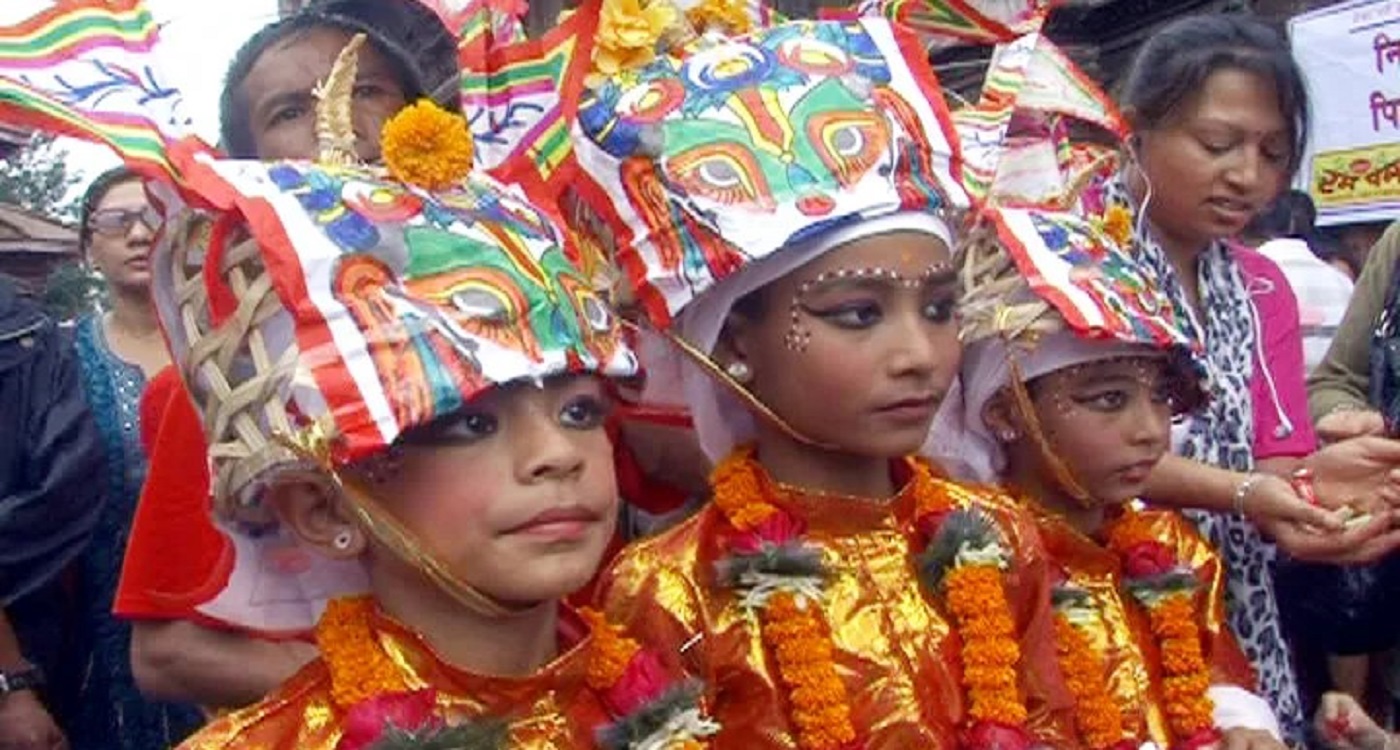
Gaijatra is a national cultural festival celebrated in Nepal. Since this festival originated from Newarculture, it is celebrated with special significanceespecially in the Kathmandu Valley and in the citieswhere Newars live. In the Newar community, it is customary to celebrate Gaijatra for the honor andliberation of the deceased fathers within a year. This festival is celebrated every year on the day afterJanapurnima, i.e. from Bhadra Krishna Paksha Pratipada to Ashtami. According to historical evidence,King Pratap Malla of the Middle Ages established the custom of celebrating Gaijatra. He was forced togo around the city in a procession to show the reality that the world was suffering like him with theintention of calming the mind of his queen. The grief of the queen was lessened when she saw therelatives of each deceased in the guise of cows coming out of their houses and participating in theprocession.
However, since the queen’s mind was not calmed by this, she managed to make him laughby presenting various comedies and satires. Legend has it that since then, Gaijatra has been celebratedevery year as per the king’s order. The tradition of performing Jatra in the Hanuman Dhoka area wherethe palace was located at that time is still alive. Gaijatra is called Saparu in Newari language. Sa meanscow and Paru means Pratipada Tithi. In Hinduism, cows are worshiped as the goddess of devotion andsalvation. As mentioned in Garuda Purana and Padma Purana, it is believed that the door of Yamlok willbe opened after taking Gaijatra to earth. There is a religious belief that by taking the cow around thecity in Gaijatra, the deceased relatives can cross the Baitarani river holding the tail of the same cow andthe way to heaven is wide.
The month of Bhadra begins after the Shravan full moon. Bhadramas beginswhen Suryanarayana enters the constellation Magha. The constellation Magha is called the constellationof the fathers. In the Rig Veda Samhita, the constellation Magha is used as an indicator of Dakshinayan.According to the scriptures, fathers are satisfied by doing patriarchal deeds after Dakshinayan Are.Therefore, the tradition of holding Gaijatra after Bhadra Krishnapaksha's position seems to be religious.During the procession, as many cows as possible and if not found, the children are adorned and takenaround the city in the guise of cows and various deities. On the day of this festival, Gaijatra tableaus canbe seen in the Kathmandu Valley and in the main cities of the country.
Today, it is customary to singcompassionate songs of Ramayana for the peace of thedeceased. Such comedians try to make theirgrieving relatives laugh. In this way, the salvation and welfare of the departed soul is wished in Gaijatraon the one hand, and on the other hand, this festival also gives inspiration to forget the pain and grief oflosing a relative and starting doing karma yoga again. In addition, various instruments, cultural dances andNewari cuisine add to the liveliness of the festival. As there is a big festival in Rajdhani Upatyaka, thisday is a public holiday in Kathmandu Upatyaka. In recent times, Gaijatra has been established as afestival to highlight the genre of comedy. On the occasion of this festival, various newspapers and magazines have published special issues of comedy and comedians have been pointing out the distortions and anomalies in the society and the nation through satirical comedy.