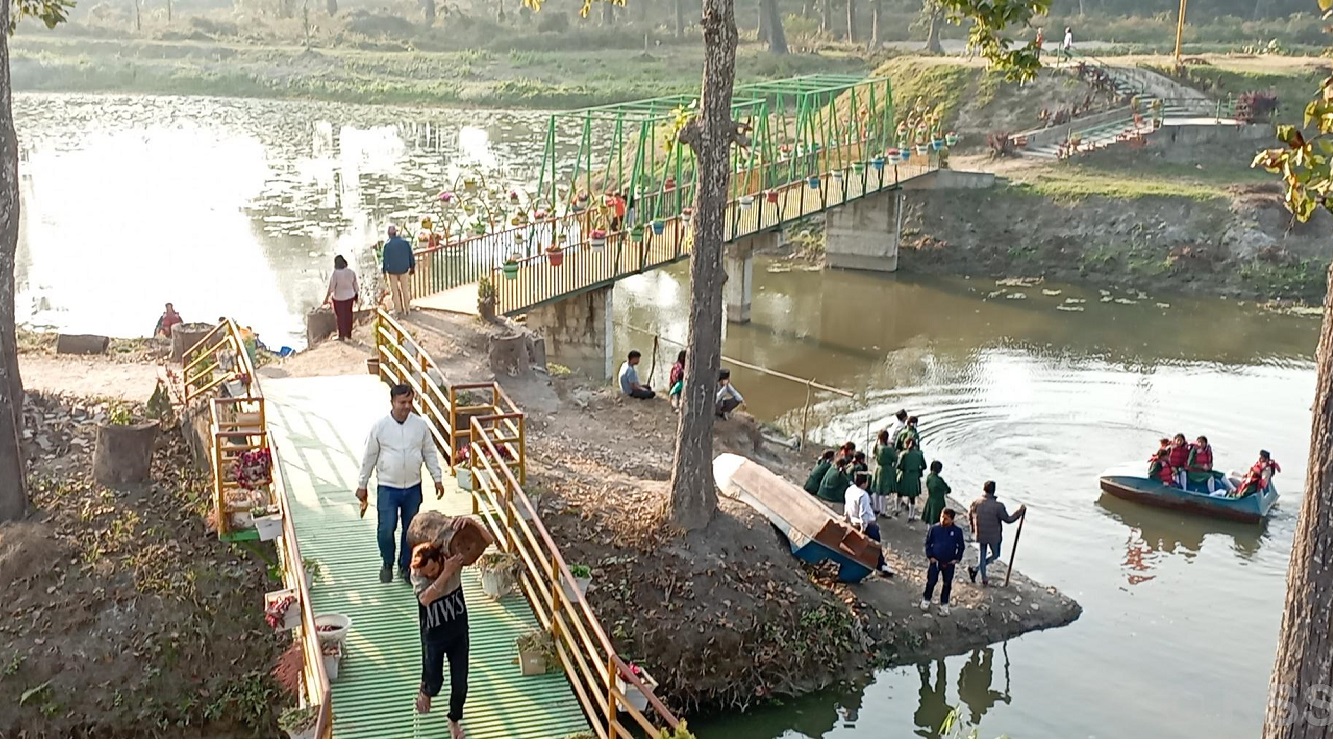
The lake was constructed by managing the Nichajhoda wetlands, and the Jhapa Hatmalo Community Forest, which is situated in Mechinagar municipality-13, has enhanced the lake’s tourism appeal. Known as “Fewatal,” the lake was created by damming the natural wetlands on all sides and placing it in the center of the communal forest. The 32 bighas of marsh and open space that make up the tourist area are part of the 390 hectares of woodland that make up the communal forest. Within the space of more than 20 bighas, there is a lake. For the amusement of visitors, the lake is manned by six boats.
The majority of visitors to this area, according to Chandra Sigdel, Chairman of the Forest Committee, take a boat journey, therefore the The community forest’s revenue stream has expanded. The sal forest that surrounds the lake adds to the area’s natural attractiveness. Both local and foreign visitors are coming here in greater numbers, bringing forest cuisine with them. The committee reports that 52 thousand visitors, both domestic and foreign, arrived in January of this year.
According to him, a number of buildings have been constructed in line with the idea to transform this region into a premier tourism destination. When the number of domestic tourists has begun to decline, so has the number of small shops and cafés. The villagers’ quality of life has improved as a result. He said that this year, 100,000 fish had been released into the lake this year with the aim of increasing the domestic income as well as entertainment for the tourists. The attraction of tourists has also increased in this scheme as the facility to buy the fish reared in the lake and to cook and eat it there has also been made available to the tourists. “After expressing the wish that most of the tourists visiting the lake would be able to go fishing, we have arranged for it”, President Sigdel said, “Indian tourists have started coming from Darjeeling and Siliguri in India for fishing.” Tourists are packed here on Saturdays and holidays. The committee said that investments are being made to make this area more orderly and build more infrastructure, which is three kilometers south of Charali Chowk on the East-West Highway.
Phewa Lake in Pokhara is a major tourist site, with six roundhouses constructed to host visitors. Due to increased visitor arrivals, the forest committee intends to build 20 more roundhouses. The lake’s development, management, and infrastructure have cost around 25 million rupees in total. Excavating the marshes has extended the lake area, allowing for the construction of roads, electricity, and drinking water facilities. Two elegant bridges, a 20-foot-high security post with an attractive entrance, a wire mesh fence, and a lovely garden have all been built. The Mechinagar-13 Ward Office and Mechinagar Municipality have set aside funding for the construction of a steel bridge, water fountains, a children’s park, and watershed protection.
The committee intends to safeguard endangered objects, construct a museum, employ wooden rope tape, and build monasteries and religious structures that reflect local culture. Agrotourism is also proposed for the region. 35 of Jhapa’s 59 community forests are creating planned tourist zones, with the Nichajhoda Wetland Para-tourist Area in Hatemalo Forest having all-round potential. The Rajvanshi and Dhimal communities populated the area prior to 2035, and the Nepalese army assumed responsibility for forest maintenance following the creation of the Nepalese army barracks in Charali. The Hatemalo Community Forest User Group was established in 2063 to manage woods around the country.
Fewatal: Jhapa
 SANN News
3.2K
shares